

Regulatory Requirements for BFS Containers
Navigating the Regulatory Matrix for BFS SVP Containers
The production of Small Volume Parenteral (SVP) containers using Blow-Fill-Seal (BFS) technology presents unique challenges for quality assurance and regulatory compliance. Governed by stringent international standards — most notably the revised EU GMP Annex 1 and various United States Pharmacopeia (USP) chapters — manufacturers must deploy robust, validated methodologies to guarantee both Container Closure Integrity and Visual Inspection.
The Regulatory Essentials for BSF
Blow-Fill-Seal (BFS) technology offers considerable contamination-control advantages by forming, filling, and sealing a container in a single automated, continuous process. However, the thermal and mechanical stresses inherent to polymer extrusion introduce specific risk profiles, such as micro-fissures or incomplete head fusion. To mitigate these risks, various regulatory bodies have established standards that mandate objective, physics-based verification of both container sterility and visual purity.
CCIT under EU GMP Annex 1
The publication of the revised EU GMP Annex 1 fundamentally redefines the expectations for Container Closure Integrity Testing (CCIT). The regulation differentiates testing methodologies based on the closure mechanism:
Fusion-Sealed Containers (Section 8.22)
For glass ampoules, BFS cards, BFS bottles, and other SVP containers with a total volume of <100ml, the mandate is absolute: 100% Integrity testing must be performed using validated methods.
For Large Volume Parenteral (LVP) containers exceeding 100ml, statistical sampling may be acceptable, provided it is backed by a comprehensive, data-driven scientific justification.
The most critical paradigm shift is contained within the clause specifying that visual inspection is not considered an acceptable integrity test method. Under current guidelines, visual appearance is decoupled from sterility assurance.
Containers Sealed by Other Methods (Section 8.23)
In contrast to thermal fusion, components utilizing mechanical or compression seals must be regularly checked for integrity using validated methods. The testing frequency must be dictated dynamically by empirical knowledge and historical experience with the specific container-closure system. Furthermore, a scientifically justified sampling plan must be maintained, establishing sample sizes derived from comprehensive supplier, packaging material, and process capability knowledge.
The USP <1207> Alignment
To satisfy these mandates, global regulators heavily reference the USP <1207> framework, which establishes a clear preference for deterministic test methods (e.g. differential pressure testing, headspace analysis) over probabilistic ones (e.g., liquid dye ingress). Deterministic methods rely on quantitative, highly repeatable physical measurements, providing an objective, human-independent verification of the microbial barrier's permanence.
The Visual Inspection Compendial Framework
While CCIT addresses physical barrier continuity, the product must simultaneously comply with strict particulate matter limitations and cosmetic defect restrictions to ensure patient safety during clinical administration.
Core USP Chapters regarding BFS
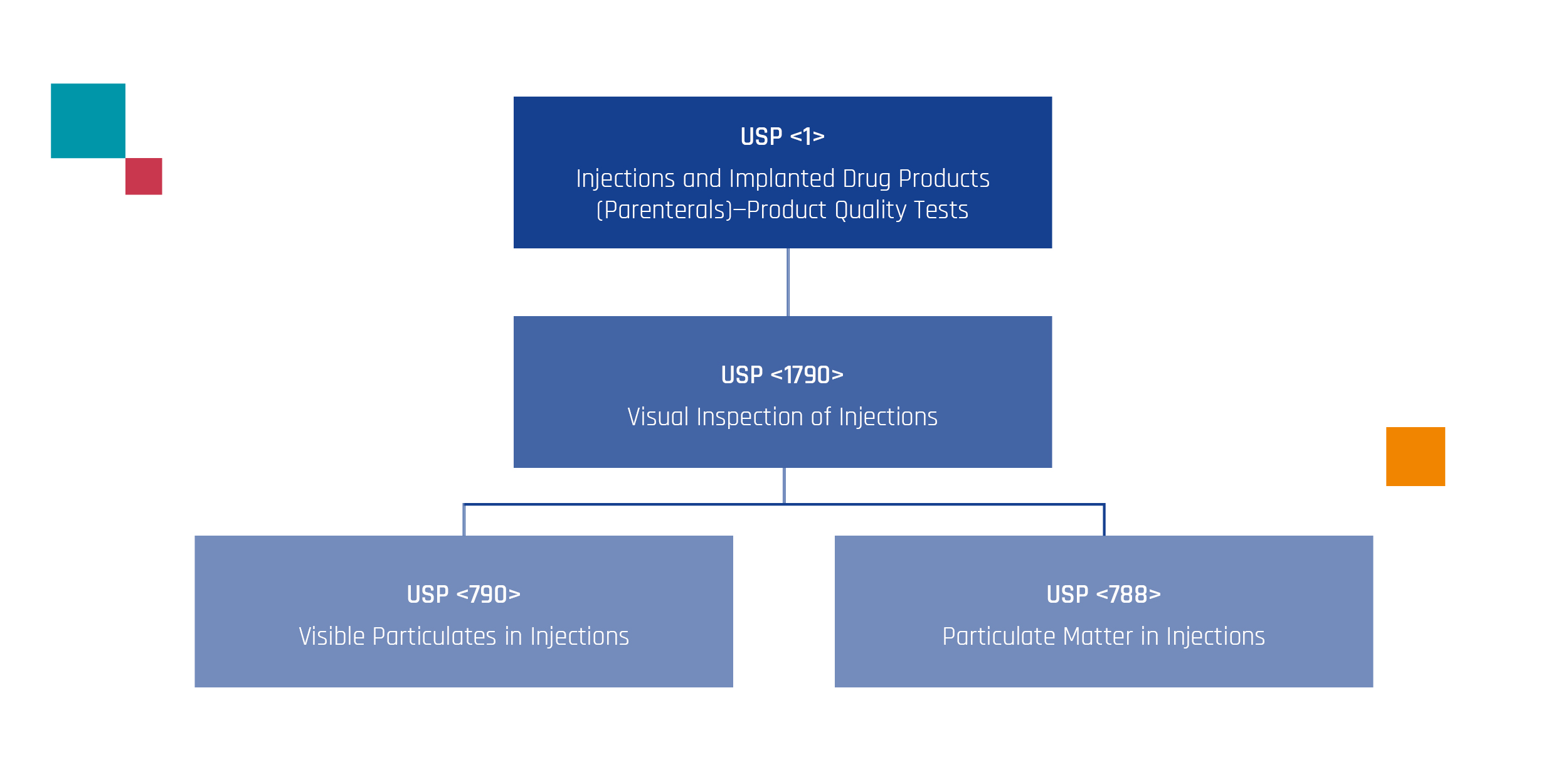
USP <1> (Injections): Dictates the core requirement that all parenterals must be sterile, free from visible evidence of turbidity, and essentially free from visible particles. It legally mandates a 100% visual inspection of every single finished unit in a batch.
USP <1790> (Visual Inspection of Injections): Functions as a comprehensive blueprint for the entire inspection lifecycle. It details the construction, governance, and management of specialized defect test sets (Knapp sets) and outlines formal validation protocols for Automated Visual Inspection (AVI) platforms. It furthermore mentions that automated systems need to be as good, if not better than manual inspection.
USP <790> (Visible Particulates in Injections): Standardizes the physical environment required for valid visual inspection. E.g. it defines precise illumination intensities — ranging between 2,000 and 3,750 lux at the inspection point — and mandates inspection against a high-contrast split black-and-white background.
USP <788> (Particulate Matter in Injections): Establishes the quantitative baselines and standardized analytical testing criteria (such as light obscuration or microscopic evaluation) for subvisible (non-visible) particles within standard injection solutions.
Ophthalmic and Difficult-to-Inspect Container (DIP) Deviations
Because BFS containers are typically composed of translucent or opaque polymers, specialized regulatory sub-chapters must be applied.

Technical Accommodations for DIP Configurations
USP <1790> provides a formal regulatory justification for utilizing modified or alternative inspection strategies when processing Difficult-to-Inspect Containers (DIP). Crucially, any modification to standard testing must be integrated into a comprehensive lifecycle control strategy designed to actively trend data, monitor the manufacturing environment, and isolate the root process sources of particulate generation.
Furthermore, USP <790> dictates that if a container-closure system restricts visual capability due to its physical opacity or structural geometry, additional validated inspection methodologies (including statistical destructive testing) must be added to the quality matrix.
Ophthalmic preparations delivered via BFS technology require careful compendial navigation due to their unique routes of administration:
Qualitative Guidelines (USP <771>): Establishes the holistic framework for ophthalmic products, enforcing explicit boundaries for sterility, pH stability, formulation viscosity, and container closure integrity. Under USP <771>, topical ophthalmic products must comply with USP <790>. Standard ophthalmic injections must satisfy both USP <790> and/or USP <788>. Extraocular solutions must meet USP <790> and/or USP <789>. For complex physical products — including gels, ointments, suspensions, emulsions, or highly opaque packaging configurations — the regulation mandates a 100% inspection for package acceptability (verifying structural integrity, molding form, and dimensional criteria), while permitting alternative, validated quality strategies for internal particulate tracking.
Stricter Subvisible Limits (USP <789>): When evaluating highly sensitive ophthalmic solutions, USP <788> is frequently superseded by USP <789> (Particulate Matter in Ophthalmic Solutions), which enforces significantly stricter quantitative limits for subvisible particles.
Compendial Exemptions: To account for formulation physics, emulsions, gels, suspensions, and certified medical devices are fully exempted from the subvisible testing criteria of USP <789>.
Mathematical Validation via Probability of Detection (PoD)
To satisfy regulatory auditors during the validation of an AVI platform for BFS SVPs, manufacturers must mathematically define the system's performance using the Probability of Detection (PoD) framework outlined in USP <1790>.
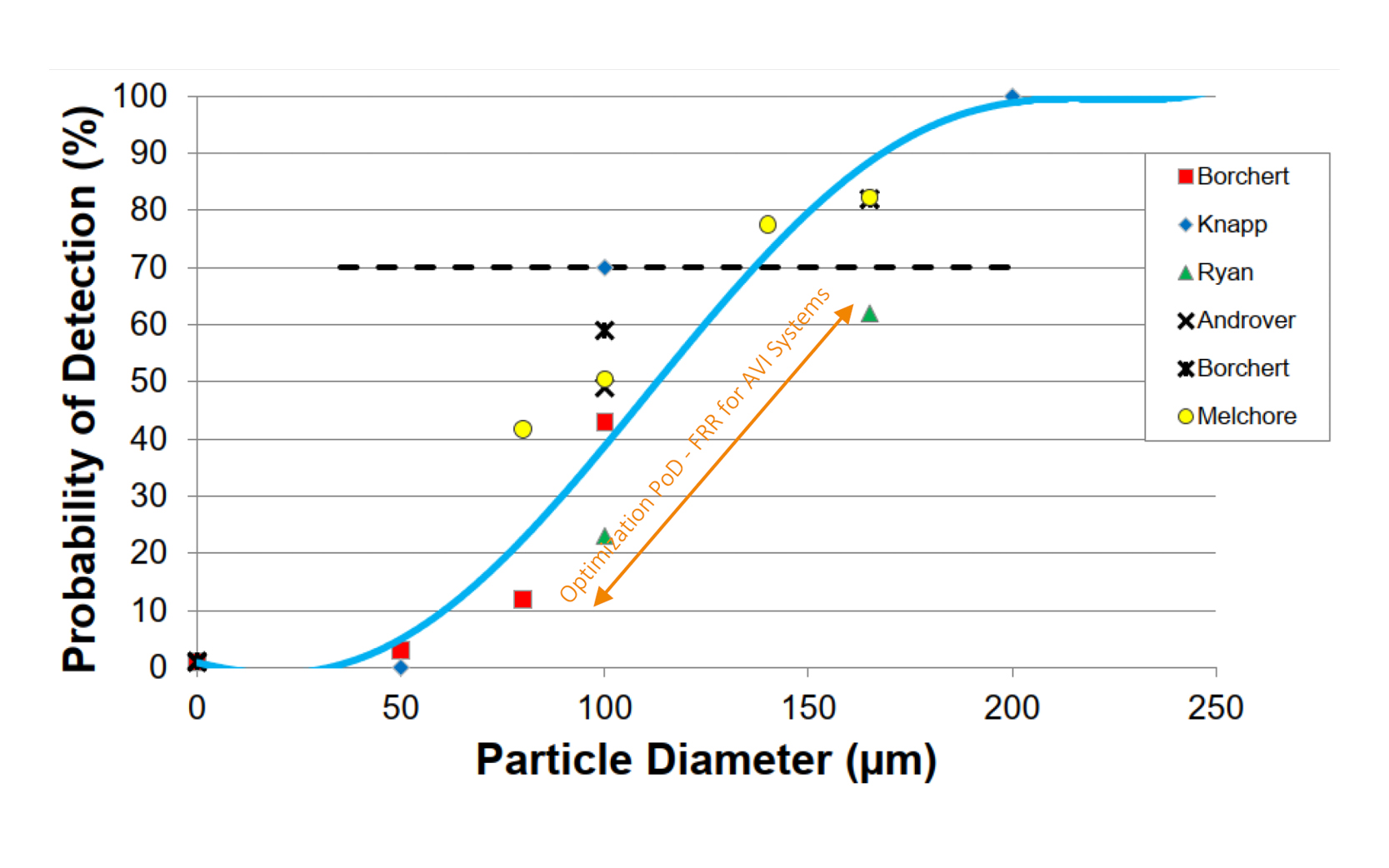
PoD acts as a statistical mapping of reliable detection relative to defect morphology. For clear glass containers housing clear solutions, the standard baseline for a routine, high-confidence automated inspection is defined as a PoD >70%. The empirical detection curve follows a strict sigmoidal distribution:
- Round Particles: A particle size of 50μm registers a PoD near 0%; a 100μm defect achieves a 50% PoD; and a size of 150μm is required to cross the reliable 70% PoD threshold.
- Fibrous Defects: Due to orientation dynamics and variable aspect ratios, a fiber must typically exceed > 500μm to reliably hit the same 70% PoD baseline.
The DIP Shift in PoD Modeling
When validating the translucent polymer materials standard in BFS cards, the light attenuation caused by the plastic wall shifts the entire sigmoidal PoD curve to the right. Because the material is classified as a Difficult-to-Inspect Container, regulators allow for higher reliable detection thresholds.
Depending on polymer density, wall thickness, and geometry, the validated detection threshold may be adjusted to 300μm, 500μm, or 1,000μm. Manufacturers must demonstrate compliance by testing physical Knapp sets tailored to their exact container configuration to empirically prove and defend what specific particle sizes are technically detectable on the production line.
Conclusion
Achieving regulatory compliance for BFS SVP manufacturing requires a clear understanding of decoupled testing mandates. Integrity testing can no longer be achieved via visual inspection; it demands 100% deterministic, physical validation as outlined in EU GMP Annex 1 and USP <1207>. Simultaneously, the visual inspection framework must balance standard compendial chapters with specialized ophthalmic and DIP carve-outs. By grounding inspection validation in empirical PoD testing and structured Knapp sets, manufacturers can successfully defend their quality control strategies under global regulatory inspection.
Get more information
Looking for automated leak detection solutions?
We are happy to advise you personally.
