

360° Vial Inspection with AVI
Maximizing Robot-Guided Visual Automation
Eliminating optical blind spots on a vial requires moving beyond traditional mechanical transport. Standard conveyor components like star wheels, rollers, and side guide rails inevitably create physical contact points that shield portions of the container from view. To achieve a true 360° Automated Visual Inspection (AVI), the container handling system must function as an active extension of the optical path itself.
By fully utilizing the multi-axis capabilities of high-precision robotic manipulation, the EVO platform from WILCO eliminates classic mechanical occlusion zones. This design approach transitions the robot from a simple transfer mechanism into an intelligent handling solution that exposes every surface of the vial to high-resolution camera stations.
100% Comprehensive Analysis of Critical Target Zones
Securing complete visual inspection across the entire container requires focusing intensely on structural transitions.
| Vial Region | Inspection Approach & Innovation | Critical Defect Typologies |
| The Stopper & Cap | Multi-angle illumination combined with precise side-view and inner-view imaging channels to eliminate hidden dead areas. | Deformities, particle contamination, cap skewness, missing flip-offs, crimping quality. |
| The Heel & Bottom | Integrated multi-angle bottom station utilizing specific reflective illumination paths while the robot suspends the vial. | Micro-cracks, scratches, glass chipping, embedded heavy particles (metal/glass/polypropylene). |
| The Container Body | Capturing a full surface. | Wall cosmetic defects, scratches, outer/inner surface impurities, lyo cake consistency. |
Through rigorous risk assessment, two regions stand out as the most critical: the heel and the stopper.
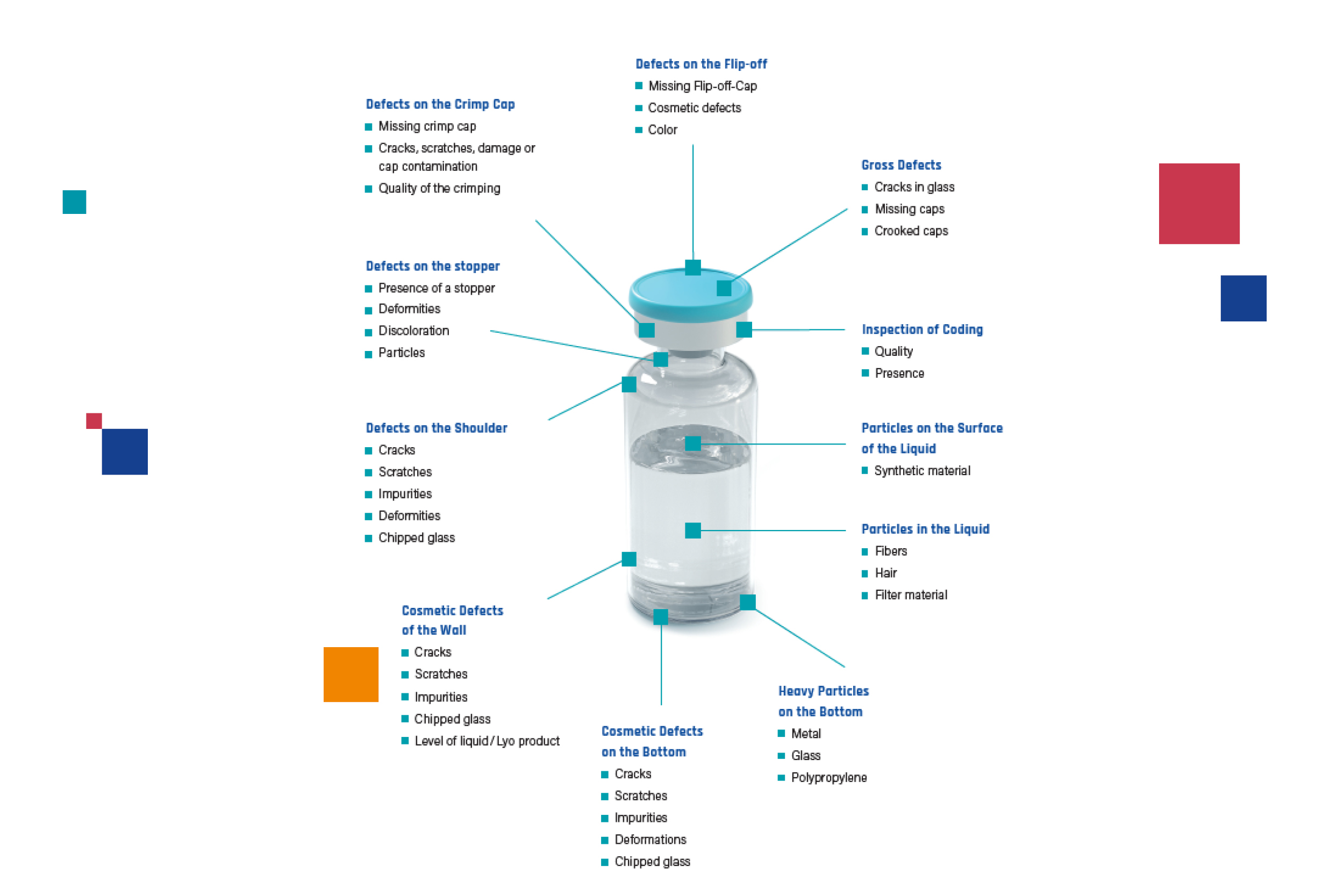
The Critical Importance of Heel Inspection
The container heel — the curved transitional zone bridging the vertical cylinder wall to the horizontal bottom surface — is one of the most mechanically stressed and vulnerable regions of a vial. Micro-fissures or stress cracks can easily develop here during glass forming, transport, or cooling cycles.
Detecting heel defects is vital for two distinct reasons:
- Structural Reliability: A minor micro-crack in this region can propagate under thermal stress during lyophilization or mechanical pressure during capping, leading to vial breakage inside the production machinery.
- Sterility Maintenance: Even if a crack does not cause immediate structural failure, it acts as a capillary pathway that compromises Container Closure Integrity (CCI), introducing an immediate threat to the sterility of the product.
To address this without increasing the physical size of the machinery, advanced heel inspection optics are integrated directly into the existing bottom camera station. Combining several complex visual inspection tasks into a single multi-view location allows the EVO platform to maintain an incredibly compact footprint while expanding its inspection capabilities.
Impact on False Reject Rates
In the EVO platform, the stopper area is evaluated via a complex setup providing several views of the stopper, including angled side views and inner views. This layout is engineered to minimize dead areas as close to zero as physically possible.
However, adding optical angles introduces a classic machine-vision engineering paradox: if you implement too many independent Regions of Interest (ROIs) or apply overly sensitive processing algorithms across too many viewpoints, the cumulative False Reject Rate (FRR) will mathematically increase. This leads to the unnecessary rejection of acceptable products, reducing overall equipment effectiveness (OEE).
Engineering Benefits of Robotic Handling
Integrating robotics provides distinct mechanical advantages that directly safeguard product quality and broaden detection capabilities. For delicate configurations like lyophilized cakes, abrupt stop-and-go movements or mechanical shocks can fracture the cake or induce cosmetic micro-cracking along the inner glass wall. The robot's customizable acceleration curves ensure exceptionally smooth movement profiles, minimizing physical stress on fragile formulations.
Detecting heavy, dense, or reflective particles settling at the bottom of a liquid formulation depends heavily on fluid dynamics. Instead of using a rigid spin-and-stop mechanism, the robot applies tailored spin, tilt, or inversion sequences designed around specific fluid viscosities and fill volumes. This optimizes the particle mobilization path right before the vial enters the camera's field of view, significantly increasing the probability of detection (POD).
Traditional systems hold vials by their base or support them from below, rendering the lower heel completely invisible during lateral view cycles. The robotic gripper engages exclusively with non-critical contact regions, allowing simultaneous optical access to both the lower heel radius and the bottom container surfaces.
A New Benchmark for AVI Platforms
True 360° vial inspection demands a holistic design where robotics and advanced optics work in harmony. This evolution stems directly from ongoing industry feedback emphasizing the need to maximize robotic capabilities for handling and presentation of the area of the product to be inspected to the dedicated camera station. By actively deploying the full dexterity of robotic handling, the EVO platform eliminates classic mechanical occlusion zones, optimizes complex bottom-and-heel station layouts to conserve floor space, and delivers high-performance multi-view stopper analysis. The result is an inspection solution that combines uncompromising process quality with exceptional operational efficiency.
