

What is Near Infrared Spectroscopy (NIRS)?
Near Infrared Spectroscopy is a non-destructive analytical technology that uses near-infrared light to obtain chemical and physical information about a sample. In pharmaceutical manufacturing, NIRS can be used to identify products, quantify parameters such as residual moisture and detect changes in lyophilized cakes. Measurements can be performed offline, at-line or inline as part of a Process Analytical Technology strategy.
Why is NIRS useful in pharmaceutical manufacturing?
NIRS enables fast, non-destructive analysis without opening or destroying the container. Unlike conventional destructive reference methods, it can be integrated into automated inspection processes and used for high-volume or even 100% inspection, depending on the application. This makes NIRS particularly valuable for Process Analytical Technology and the evaluation of lyophilized products.
Why NIR inspection is important
Residual moisture in lyophilizates is a critical quality attribute of a drug and has an impact on its long-term stability. Therefore, the moisture concentration needs to be verified. The Karl Fischer Titration is a widely used and established method for that application. However, the method requires the sample to be destroyed in order to test it and therefore does not allow a 100% inspection. Other lyo defects such as meltbacks or shrunken cakes may be detected with other methods such as visual inspection, which is limited to the inspection of the lyo surface.
How does NIRS differ from Karl Fischer titration?
Karl Fischer titration is an established reference method for determining water content, but the sample must be opened and consumed during analysis. NIRS is non-destructive and can therefore be used for repeated, at-line or inline measurements. For quantitative moisture determination, however, the NIR model must be calibrated against a suitable reference method such as Karl Fischer titration.
How does NIRS work?
Near-infrared light interacts with the sample, and the resulting absorption or reflection spectrum contains information about its chemical composition and physical condition. Chemometric models are then used to convert these spectral patterns into qualitative or quantitative results.
Working principle of Near Infrared Spectroscopy (NIRS)
NIR inspection is a process analytical technology which supports the assessment and control of the pharmaceutical freeze-drying manufacturing process through the analysis of the spectra of the freeze-dried cakes.
In the NIR spectral range in particular, overtones and vibrational combinations of OH-, NH- and CH- fundamental vibrations can be observed. The intense spectral features of most organic substances can be measured in the spectral range between 1100 nm and 2500 nm (10.000 cm-1 and 4.000 cm-1), consequently this area is widely used.

- The principal set up in which to achieve the NIR spectra in reflection mode
- The illumination using tungsten halogen lamp which illuminates the vial from below
- Light is reflected of off and scattered by the lyophilizate within the vial and then focused via a fiber optic cable at the entrance split
- Beam hits holographic grating and is reflected on photo diode array detector
- Grating splits radiation into individual wavelengths
- Detector generates digitized output signal (spectrum) to be converted
With NIR technology, changes in the cake condition can be detected more sensitively than with an optical system. This is why NIR is the preferred inspection technology for meltback defects.

NIR inspection possibilities
The measurements are performed without data pretreatments either in diffuse reflection or in transmission. The NIR spectra contain chemical as well as physical information. A simple and direct interpretation of the spectra is inconceivable. Therefore, it is necessary to use a little more extensive chemometric algorithms for interpretation and evaluation of the spectra.
Diffuse reflection
Diffuse reflection is primarily used for the investigation of powder samples, but is also used for granulates or pastes, lyophilizates, other solids as well as gels.
The NIR radiation incident on the sample, penetrates the surface and is diffracted by the particles and reflected diffusely. The reflected radiation contains the spectral information about the sample.
Advantages
- No sample preparation is needed
- chemical and physical information is gathered
Transmission
A transmission setup is the optimum method for liquids. The samples are irradiated in a defined layer thickness. The transmitted light contains the spectral information.
Advantages
- Well defined conditions
- high signal yield
What can NIRS measure in pharmaceutical products?
Depending on the product and validated chemometric model, NIRS can be used for product identification, classification, residual moisture quantification, assessment of material composition and detection of physical changes or defects in lyophilized products.
Applications
Active ingredients and auxiliary material in the solid and liquid form can be identified and quantified.
Water Activity Determination
NIRS can be used for non-destructive water activity determination when an application-specific model has been developed and validated. It can additionally provide information about moisture content and material composition, allowing several quality attributes to be assessed using the same spectral measurement.
Identification of the different products
The reliable identification of different products or raw materials as well as classification of different groups is essential in the pharma and food industry.
Why does NIRS require chemometric models?
NIR spectra contain overlapping chemical and physical information and therefore cannot usually be interpreted from individual wavelengths alone. Multivariate chemometric models are used to identify patterns in the spectra and translate them into classification or quantitative results.
Following chemometric methods are used for identification or classification:
- Cluster analysis or Principal Component Analysis (PCA)
- Support Vector Machine Classification (SVMC)
- Linear Discriminant Analysis (LDA)
- Partial Least Squares Discriminant Analysis (PLS-DA)
Quantification Methods
The results of NIR spectroscopy are obtained in real time. This allows fine adjustments in processes and increases the productivity. An example of this is measuring the moisture content in lyophilizates.
These spectra of lyophilizate are recorded and calibrated with the reference method Karl Fischer titration. The content of one or more components, based on calibrations, is determined from the NIR spectrum. These were recorded and stored in advance with samples of known content. The method Partial Least Squares Regression (PLS) is the basis for the quantitative analysis. The calibration shows accurate results for the moisture content in lyophilizate.
The NIR technology is an indirect method and requires an absolute comparison method. It is combined with the classic reference method.
For the quantitative evaluation the following chemometric method is used:
- Principal Least Squares Regression (PLS)
Hierarchical Modelling (HM)
Hierarchical Modelling (HM) is a step by step analysis for different properties on a given set of information, in the case of NIR a spectrum. It is the combination of a number of assembled, multivariate models in order to get a clear result for different properties. Sometimes a single classification or a prediction model of moisture is not enough in order to fully describe a sample or the underlying process. Therefore, a model is applied, that consists of other specific models. The user will then get a result from each of the models about one property of the sample and the underlying process.
Example Hierarchical Modelling (HM) for product A
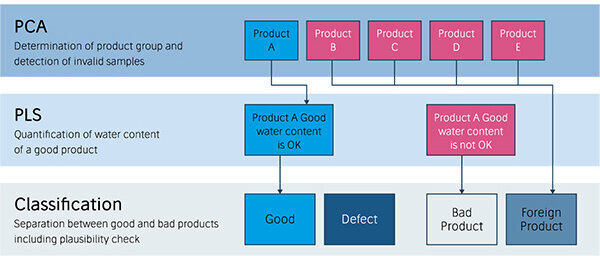
The HM Model of the process analysis consists of the following steps:
1. Identification of the product
The PCA qualitative analysis is used for the identification of different products. PCA shows the ability to discriminate between the different populations of the sample classes.
2. Moisture evaluation
The PLS quantitative analysis is used for the determination of water content in the cake. The correlation between spectral data and the corresponding water content values, using Karl Fischer method as reference analysis, of the individual components is created using PLS algorithm.
3. Cake defect classification
SVM algorithm is used for the classification of different classes, for example, the separation between good and bad classes of the cake based on defects.
When should NIRS be used?
NIRS is particularly suitable when chemical or physical product attributes need to be assessed non-destructively and rapidly. Typical applications include residual moisture measurement in lyophilized products, product identification, material classification and process monitoring. The method requires application-specific model development and suitable reference data, which makes feasibility studies and validation essential parts of implementation.
Why combine NIRS with other inspection technologies?
Different technologies measure different quality attributes. For lyophilized products, for example, AVI can assess particles and cake appearance, NIRS can evaluate residual moisture or product characteristics, and Headspace Analysis can measure gases or headspace pressure. Combining these methods can provide a more comprehensive assessment within one inspection process.
Versatile NIRS solutions
The semi-automatic laboratory system is suitable for model development. Fully automatic inline solutions can process up to 600 products per minute in production. The NIR solution can also be supplied as a single module which can be easily integrated into any production line.
Method development and validation as key to success
NIRS is an indirect analytical method. Reliable qualitative or quantitative results therefore depend on a product-specific chemometric model built from representative samples and suitable reference measurements. Model development, calibration and validation are consequently essential for a robust pharmaceutical NIR application. As a reference method the Karl Fisher method is used.

Advantages of our NIR inspection solutions
- Extremely short measuring times – non-destructive
- Exact and validatable measurement values (data driven PAT)
- Environmentally friendly – no sample preparation, no chemical wastes
- Safe – no chemical reactions
- Versatile – simultaneous determination of various parameters
- Online application for process control
- Easy to use – user-friendly application
- Can reduce the need for time-consuming wet-chemical analyses in suitable, validated applications.
- Validated quantitative NIR models can achieve strong correlation with established reference methods such as Karl Fischer titration within the defined application and calibration range.
Would you like more information about the PAT possibilities with NIR spectroscopy?
We will be happy to advise you personally.
